In the deep green valleys of inland Galicia, where terraced vineyards fall dramatically toward the River Miño and ancient monasteries cling to cliffsides, a quiet renaissance is underway. The Ribeira Sacra — once one of Spain’s most overlooked wine regions — is now emerging as one of the country’s most sought-after rural destinations.
At the heart of this landscape, just outside the small town of Pantón, stands Pazo de Ferreiroá, a noble house whose story mirrors the history of Galicia itself.
A House Rooted in Six Centuries of History
The archives of the estate reach back to 1403, placing the origins of the property deep in the medieval history of the region. At that time Galicia’s countryside was organised around large agricultural estates owned by noble families, monasteries and local lords.
By the early eighteenth century, the house had taken the form we see today: a grand Galician pazo — the distinctive manor houses that once served as the administrative and social centres of rural estates.
During this period the property belonged to the influential Pallares and Gayoso families, prominent names in the Galician aristocracy. Their prominence was recognised in 1816, when the head of the family received the title Count of Pallares, elevating the estate to one of the region’s notable noble residences.
Over time, as was common with historic estates, the property passed through marriage and inheritance. In the late nineteenth century it entered the hands of the Pardo Salgado family, later becoming connected to the Arias family of the Pazo de Maside.
Their legacy remains visible in the heraldic coats of arms carved into the stone façades, bearing the symbols of some of Galicia’s most historic families — Losada, Osorio, Quiroga, Somoza, López-Lemos and Saavedra — silent witnesses to centuries of alliances and lineage.
Architecture of a Classic Galician Pazo
Approaching the estate today feels much the same as it would have centuries ago. A long alameda lined with ancient oak trees leads to the entrance gate, crowned with a stone crest.
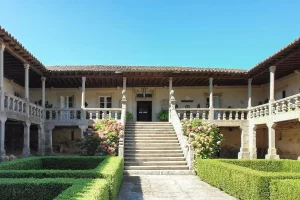
The building itself is arranged in the traditional U-shaped layout, enclosing a forecourt and creating the sense of a self-contained manor complex. From the courtyard rises the pazo’s architectural centrepiece: a grand granite staircase with elegant balustrades, leading to the planta noble, the principal living floor.
Inside are expansive rooms that once hosted gatherings of clergy, local nobility and visiting dignitaries. The house includes reception salons, a library, formal dining room, and even a ballroom, reflecting the social life that once revolved around such estates.
Beneath the house lies an impressive stone wine cellar of around 300 square metres, a reminder that wine has always been at the centre of life in this region.
The Palacios Family Restoration
In more recent years the estate entered a new chapter under the stewardship of Manuel Palacios and his family, who undertook the careful restoration of the property.
Rather than modernising the house beyond recognition, their approach was guided by respect for the building’s historic character. Roofs were repaired, carpentry restored, and structural elements stabilised, while the interiors were revived with sensitivity to the building’s past.
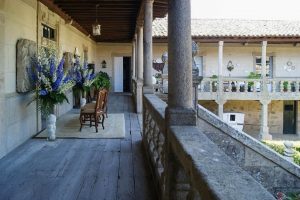
The Palacios family also introduced a remarkable collection of period furnishings and historic decorative pieces. Antique chests, carved wooden tables and traditional Galician furniture filled the rooms.
Particularly striking was their appreciation for historic textiles. Embroidered tablecloths, lace window dressings and antique fabrics were used throughout the house not only for decoration but as expressions of regional craftsmanship. These pieces gave the interiors a warmth and authenticity that modern restorations often lack.
The result is a house that feels both lived-in and timeless — a place where the past remains present in every detail.
A Landscape Rediscovered
Today the pazo sits within more than two hectares of land, surrounded by gardens and parkland, with additional historic estate lands nearby.
Its location in Ribeira Sacra is increasingly significant. Over the past decade this once-quiet region of Lugo and Ourense has become one of Spain’s most intriguing destinations for those seeking authenticity, landscape and culture.
The name Ribeira Sacra — meaning “Sacred Riverbank” — refers to the extraordinary concentration of medieval monasteries that line the canyons of the Miño and Sil rivers. These monks were also responsible for introducing viticulture here centuries ago, creating the steep terraced vineyards known today as heroic viticulture.
The region now carries a Denominación de Origen (D.O.) for its wines and is attracting increasing attention from international visitors, wine lovers and buyers searching for historic rural properties.
Unlike Spain’s more developed coastal areas, Ribeira Sacra remains wild, peaceful and deeply authentic — a rare combination that has made it one of the country’s newly sought-after locations for restoration projects, boutique hotels and private estates.
Life in the Valley
Despite its tranquil setting, the pazo is far from isolated. The town of Ferreira de Pantón provides everyday services, while the historic town of Monforte de Lemos, just fifteen minutes away, offers schools, hospitals, shops and rail connections.
Within easy reach are the famous thermal baths of Ourense, the cultural capital of Santiago de Compostela, and the Atlantic city of Vigo — all within roughly ninety minutes by car.
A Noble House Waiting for Its Next Chapter
What makes Pazo de Ferreiroá special is not simply its architecture or scale, but its continuity.
From medieval land records to aristocratic titles, from centuries of rural life to the careful restoration by the Palacios family, the estate has evolved while preserving its identity.
Today, as Ribeira Sacra quietly emerges as one of Spain’s most desirable inland regions, this historic manor stands ready for its next chapter — a rare opportunity to become part of a landscape where history, nature and culture remain beautifully intertwined.